

News on food and beverages in the world
Provided by AGP
Autonomous Coffee Shops to Transform Operations at Airports, Hospitals, and Transit Hubs by 2027
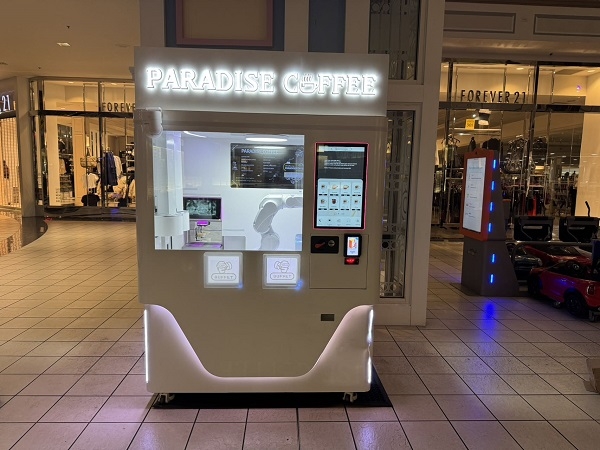
The evidence is converging from three directions. First, hospitality labor in developed markets has moved from cyclical shortage to permanent constraint: the U.S. Bureau of Labor Statistics continues to log food-service quit rates above 4.5 percent monthly, and European operators report that staffing a single 24-hour airside location now requires 6 to 8 full-time equivalents at fully loaded costs exceeding $300,000 annually. Second, captive-audience venues — the very locations where coffee demand is most inelastic — are precisely where staffed operations fail most often, because overnight, holiday, and shoulder-hour shifts cannot be reliably filled. Third, the hardware-software stack required to replace a barista has crossed the reliability threshold. Six-axis robotics, computer-vision pour control, and remote telemetry have matured to the point where a robotic cafe can now produce latte art indistinguishable from a trained professional, on a 90-second cycle, 8,760 hours a year.
For procurement leads, facility directors, and concession managers, the strategic question is no longer whether autonomous coffee will arrive in their venues. It is whether they will be the operator who deploys it first in their catchment area, or the one who watches a competitor capture the captive footfall.
Why Captive-Audience Venues Are the Forcing Function
Airports, hospitals, intercity rail terminals, and 24-hour office complexes share a profile that makes them uniquely hostile to traditional café staffing. Demand is non-negotiable — a surgeon ending a 14-hour shift at 3 a.m., a delayed passenger waiting for a 5 a.m. boarding call, a night-shift logistics worker — but supply is structurally fragile. A single barista calling out can shutter a location for an entire revenue window. In hospital settings, infection-control protocols and limited back-of-house space further complicate staffed operations.
These are also the venues where the cost of a closed shutter is highest. A shuttered airside café during a delay event is not just lost coffee revenue; it is a measurable degradation of passenger experience that airport authorities increasingly track in concession KPIs. Hospital administrators face similar scrutiny from patient-satisfaction surveys. The autonomous model resolves both problems at once: the unit runs continuously, draws power rather than payroll, and reports performance telemetry to a central dashboard.
This is the operational logic driving the shift to the coffee robot as a fixed-asset alternative to the staffed concession. It is not a gimmick play. It is a labor-arbitrage and uptime-arbitrage play, and the venues feeling the pressure first are the ones where uptime matters most.
The Hardware Threshold Has Quietly Been Crossed
For a decade, robotic coffee was a novelty — interesting at trade shows, embarrassing in deployment. The cycle times were too slow, the drink quality was too inconsistent, and the maintenance overhead consumed any labor savings. That gap has closed. Modern six-axis arms paired with high-precision vision systems can now execute professional-grade latte art through machine-learning-trained pour paths, modeled in 3D and replicated to within millimeters of a master barista's technique. Menus have expanded from a handful of espresso variants to 26-plus customizable SKUs spanning hot and cold coffee, printed-image specialty drinks, juices, light milk teas, and chocolate beverages.
One concrete indicator of where the category sits today comes from Shenzhen-based RobotAnno (Anno Robots), which in 2025 introduced what it describes as the world's first enclosed single-arm robotic latte-art and printing coffee kiosk — a unit recognized with the 2025 AI Tianma Award. The specifications are instructive less as a product pitch and more as a benchmark for what operators should now expect from any serious vendor: a 90-second full-cycle latte-art drink, a 200-cup hopper capacity, configurable milk temperature held at 2–4°C, 24/7/365 continuous operation, and a backend that supports remote monitoring, multi-dimensional sales analytics, and PC- and mobile-based menu management. Payment integration spans WeChat and Alipay domestically and card, bill, and coin acceptance for international deployments. The footprint — roughly 1.7m by 1.45m — fits within the envelope of a standard concession bay.
The single-arm enclosed architecture is itself a signal. Earlier-generation dual-arm and open-frame designs created hygiene exposure, higher mechanical failure rates, and a larger footprint. The convergence on enclosed single-arm units reflects what venue operators have been demanding: smaller footprint, food-safety compliance, and a serviceable mean-time-between-failure profile. Operators evaluating the category can review current configurations and deployment case studies at www.annorobots.com as part of a broader vendor benchmarking process.
The Unit Economics That Will Decide the 2027 Procurement Cycle
The financial case for an autonomous coffee shop is no longer marginal. Consider a typical 24-hour airside location producing 400 transactions per day at an average ticket of $5.50. Annual revenue sits near $800,000. Under a staffed model, fully loaded labor for true 24/7 coverage runs $280,000–$340,000, before benefits-related attrition costs. Rent, COGS, and overhead consume another $300,000–$380,000. Net margin, in a good year, lands between 8 and 14 percent — and that assumes no shift gaps.
An autonomous unit replaces the labor line with a fixed-asset depreciation schedule, a remote-monitoring contract, and a part-time technician who services multiple sites. The combined operating cost typically lands 50 to 65 percent below staffed equivalents, and uptime moves from roughly 70 percent (accounting for overnight closures and call-outs) to north of 95 percent. The compounding effect — more hours open, lower opex, higher throughput per square meter — is what will trigger the procurement reckoning.
Key Takeaways for Operators Planning the Next Concession Cycle
The labor constraint is structural, not cyclical. Planning concession refreshes around an eventual return of cheap hospitality labor is a strategic error. Build procurement assumptions around persistent scarcity.
Uptime is the new revenue lever. In captive-audience venues, the difference between 70 percent and 95 percent operational uptime is worth more than any menu engineering exercise.
Drink quality is no longer the bottleneck. Vision-guided latte art and 26-plus SKU menus mean the autonomous category now competes on product, not just convenience.
Footprint and hygiene drive vendor selection. Enclosed single-arm architectures will displace open-frame and dual-arm designs in regulated environments such as hospitals and airside zones.
Telemetry is the moat. Operators should weight backend analytics, remote menu control, and predictive-maintenance data as heavily as the hardware itself. A robotic cafe without a serious data layer is just a vending machine.
Where the Category Goes Next — and What to Do About It Now
The 2025–2027 window will be defined less by technology breakthroughs than by deployment learning curves. The operators who place autonomous units into live venues this year will accumulate two years of operational data — consumer behavior patterns, peak-hour throughput optimization, maintenance interval refinement, menu mix tuning — that late movers will have to acquire from scratch. In a category where venue exclusivity contracts run five to ten years, being the second mover in a given airport terminal or hospital campus may mean being locked out of that location for the rest of the decade.
The harder question for industry professionals is not whether to pilot, but how to structure the pilot so it produces decision-grade data. That means choosing venues with genuine 24-hour demand rather than novelty foot traffic, instrumenting the unit for granular SKU-level and hour-level analytics from day one, and negotiating concession terms that allow rapid scale-out if the pilot validates. It also means treating the autonomous coffee shop not as a replacement for a single barista, but as a network asset — one node in a fleet that can be centrally managed, remotely updated, and continuously optimized.
The operators who will win the next concession cycle are the ones who recognize that the choice is no longer between a good café and a robotic one. It is between an asset that runs every hour of every day and one that closes when its staff cannot show up. By 2027, that distinction will be the line between concessions that scale and concessions that quietly disappear.
Anno Robot
RobotAnno(ShenZhen) Co., Ltd.
+86 166 0286 0929
celine@annorobots.com
Visit us on social media:
LinkedIn
Facebook
YouTube
Legal Disclaimer:
EIN Presswire provides this news content "as is" without warranty of any kind. We do not accept any responsibility or liability for the accuracy, content, images, videos, licenses, completeness, legality, or reliability of the information contained in this article. If you have any complaints or copyright issues related to this article, kindly contact the author above.
